Scott Carey—Beth father-daughter relationship
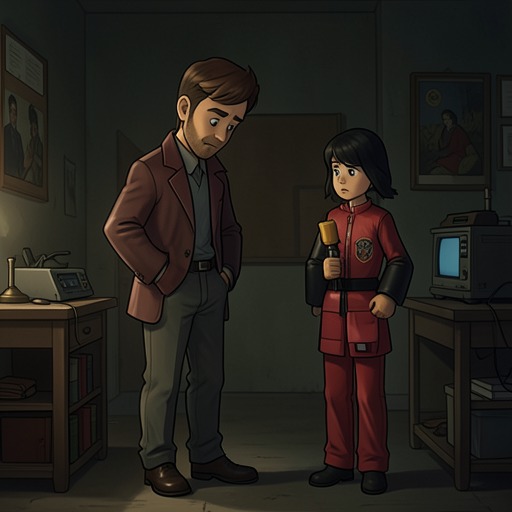
The Shrinking ManScott Carey—Beth father-daughter relationship is shaped by a painful contradiction: Scott remains Beth’s father, yet his progressive shrinking weakens the physical presence and familiar authority through which she has known him. Their bond is not erased at once; it is worn down amid meals, bedtime routines, financial pressures, and Scott’s growing fear that he no longer belongs to his family’s world.
Family Life and the First Signs of Distance
Before size became an obvious barrier, illness and worry had already diverted Scott’s attention from Beth. His examinations and hospital stays left him less available, and at home he was so absorbed in what was happening to his body that he often failed to notice how the relationship was changing. There were still moments of closeness: he held Beth in his lap, read her stories, and sometimes stood beside her bed late at night. These memories mark the ordinary forms of fatherly care that persist even as his circumstances narrow.
Scott had imagined building security around his family through steady work, a loan, insurance, and eventually a home. His shrinking threatens that plan, and the resulting financial anxiety presses into family life. At one supper, Beth has stopped eating to watch the tense conversation about Scott’s health and the cost of treatment. Louise Carey tells her to return to her food, and Beth does so. The moment gives the crisis a child’s immediate scale: while Scott and Louise Carey reckon with medical expenses and uncertain income, Beth is present at the table but cannot understand the adult fears shaping it.
A Growing Difference in Scale
Scott’s fear is not only that he will become physically small. He wonders whether Louise Carey and Beth can still be considered his family if his size removes him from their sphere, and he imagines that Beth might crush him underfoot without knowing it. The thought turns an intimate relationship into a question of visibility and recognition: if his daughter cannot perceive him as a person, he fears that his place as her father may become equally imperceptible.
The family’s daily life makes the change gradual rather than sudden. Scott imagines months of eating, sleeping, talking, and caring for Beth together while his body continues to shrink. Each day would bring another adjustment, and familiar routines would remain entangled with the accumulating evidence of change. The bond is therefore tested not by a single separation but by repeated encounters in which the people sharing a home no longer occupy the same physical scale.
Authority and Beth’s Understanding
Scott’s diminishing size also alters the authority he can exercise as a father. He had been six feet two inches tall, while Beth was four feet one inch; their height difference, along with the depth of his voice, had helped make him seem powerful and dependable to her. As he shrinks to her height and then below it, his voice loses its former depth. The change affects how he sees himself as well as how he believes Beth sees him: his physical presence no longer automatically supports the role he is trying to maintain.
Beth cannot readily understand a father who changes in a way that has no equivalent in her experience. In her established picture of family, a father is a constant figure who can be relied upon. Scott’s transformation makes him seem different from the person she remembers, and her respect wanes as his size and voice cease to match that familiar image. His increasingly sharp outbursts deepen the problem. She is too young to interpret them through his fear and frustration, so she encounters a small, angry figure rather than the father whose changing body has made those reactions harder to control.
Scott protests that he is still Beth’s father, while Louise Carey reminds him that Beth does not understand what is happening. The protest expresses both attachment and helplessness: he insists on the relationship’s continuity precisely when its visible signs are becoming harder for his daughter to recognize. His distress repeatedly sends him back to the cellar, where he leans against the refrigerator, clenches his hands, and tries to contain himself. Meanwhile, clothes are altered, furniture becomes less manageable, and the family’s financial worries grow. These practical changes reinforce the distance without making Beth responsible for understanding what she cannot yet comprehend.
Strain, Loss, and Continuing Attachment
Scott’s withdrawal from medical testing and his anger at being treated as an object of study form part of the pressure surrounding his family role. He objects to repeated tests and their cost, while Louise Carey argues that the doctors have not finished their work. His refusal is tied to exhaustion and expense, but it also leaves the family negotiating uncertainty without a completed explanation. Beth’s place in that household makes the consequences personal: the crisis affects not only Scott’s body but the routines and security on which family life depends.
As Scott contemplates an increasingly lonely future, he tells Louise Carey that he expects her to remarry after his life is over. He explains that he still needs companionship and affection, but the episode also conveys how far he feels himself moving beyond ordinary relationships. His concern about losing Beth’s recognition belongs to the same larger fear: that shrinking will separate him from the people he loves before it ends his life. The father-daughter bond remains emotionally important, but Scott can no longer assume that love alone will preserve the authority, familiarity, or shared understanding that once made it legible.